

Whew!
I’ve been avoiding this drama because I knew it was going to be heavy, and I wasn’t in the mood to be shocked, horrified, and disappointed in humanity.
But I knew it was time to get on board and watch the acclaimed The Glory, starring Song Hye-kyo and Lee Do-hyun.
The plot summary: A former victim of school violence plans and seeks revenge on her bullies after taking up a job as a homeroom teacher at the elementary school of the bully leader’s child. (Wiki).
Now, this is what gets me with this theme in K-dramas because I just can’t imagine a situation in which society fails children so horribly. Since this is a common theme in many K-dramas, I’m led to believe there is a lot of truth to this, which makes me… le sigh.
And in fact it is.
The Glory is an amalgamation of several stories of school violence in Korea. According to this article, many scenes in this first episode, including the curling iron scene, happened to a student in Korea in 2006. The article states that school violence has always been around in Korea but with social media has gotten worse in the past years requiring the Korean goverment to write laws directed at ending school violence.
But let’s get into this episode.
WARNING: THE REST OF THIS POST MENTIONS S****DE, and SA.
Song Hye-kyo stars as the lead, Moon Dong-eun, a young girl who is suffering from unbridled school violence from her peers and school officials. Her tormentors are a group of five horrible people, Park Yeon-jin (played by Lim Ji-yeon), Jeon Jae-joon, Lee Sa-ra, Son Myeong-o, and Choi Hye-jeong.
Of the five, Yeon-jin is the leader, a wealthy, pretty girl who delights in terrorizing people. I have to give it to the actor who plays the young Yeon-jin, she embodies the sadistic satisfied look Yeon-jin has on her face when she inflicts violence on Dong-eun so expertly. I don’t know how she did it but she was chilling. There are two other wealthy bullies in the group: Jae-joon and Sa-ra. Meyong-o and Hye-jeong are come from poor working class families. So they really participate in bullying lest they be eaten.
This first episode sets us up for the theme of the show: revenge.
If you are watching a show about revenge, you must ask why the main character seeks revenge and on whom?
The catalyst for revenge is institutional failure.
When we meet our main character, teenage Dong-eun, she is in a police station, visibly bruised with bloody cuts on her face. She is pressing charges against her bullies. Her tormentors parents come in one by one and fake apologize with the platitude, “oh you should be nicer to your friends.” Of course these kids are not friends, but with agemates being an important social category in Korea, the adults simply go your classmates are your friends and you should be nice to your friends.
Dong-eun is picked up or rather signed out by an extremely annoyed homeroom teacher who proceeds to verbally bash Dong-eun for going so far as to bring her bullies up on charges.
We cut to a scene with Yeon-jin and her mother, and we see why she is the way she is…her mother is wealthy and horrible. Instead of punishing her daughter for her behavior, she tells her daughter she is disappointed that someone so low on the social totem pole put her into that situation.
Another violent scene. Yeon-jin has devised a new way to torment Dong-eun. It is in this scene that the viewer learns just how sadistic Yeon-jin is. She is truly a sociopath, no exaggerations. She is a sociopath and delights in violence. She decides that the new torment for Dong-eun will be checking her curlying iron temperature on Dong-eun’s skin. My God.
Dong-eun is locked in the school gym with these five tormentors. Jae-joon, doesn’t participate but doesn’t stop it. Sa-ra and Hye-jeong hold her down and Myeong-o puts a cherry on top by sexually assaulting her.
As Dong-eun screams for help, Yeon-jin tells her it’s useless because 1) she got the keys from the gym teacher herself by giving him a little something, somethings, if you know what I mean, and 2) no one is going to stop her because no one wants to stop her. She is beautiful and she comes from money and she can’t be stopped.
Dong-eun goes to the nurse for some medication for her wounds, and the nurse, validly concerned, asks her who has given her these vicious burns, to which Yeon-jin, who is in the nurse’s office, says, “Me, and what are you going to do about it?”
The final stage of bullying comes when her tormentors find where Dong-eun lives. Dong-eun lives in what I don’t even know, but let’s call it squalor. One room where everyone keeps their belongings outside, lined up along the wall because there is no space inside. Of course they proceed to burn her on her legs.
After going to the school nurse, I guess for an adult who will help her, and seeing that the nurse has resigned (I guess she realized fighting the school violence was of no use or she was forced to resign), Dong-eun drops out of school and, for her reason, writes down her five abusers. Enter her homeroom teacher who is livid and demands Dong-eun come back to school and change her reasoning. He is livid because as the homeroom teacher of all these students, he was supposed to intervene and he did not. Dong-eun goes to the school and basically asks the teacher how is all of this okay with you, if this was your son would you want him to have this abuse?
And the next scene astounded me.
The mention of his son , and really the truth bombs homegirl was dropping, sent Dong-eun’s homeroom teacher into a rage and he proceeds to smack her down. Several. Times!
Where is this girl’s mother? She better be dead or critically ill.
She is not. SHE IS NOT!
Yeon-jin’s mother and the homeroom teacher locate Dong-eun’s mother. Yeon-jin’s mother pays Dong-eun’s mother to keep quiet and to override the original reason she dropped out. The new reason that her mother signs for-maladjustment. Dong-eun’s rotten mother then moves out of the one room that she shared with her daughter leaving her copy of the form that she signed and leaving Dong-eun homeless.
Dong-eun worked for a year but is still suffering from physical pain and discomfort from the violence she survived, and she decides that she wants it all to be over.
Let’s talk about the cinematic juxtaposition here. As Dong-eun is contemplating ending her life, the five tormentors and sitting in a hotel room, with room service and the finest alcohol and Yeon-jin asks Jae-joon, do you think Dong-eun is pretty? Girl, What?!
Dong-eun decides that she isn’t going to die. She goes back to the school and tells Yeon-jin that her life dream is Yeon-jin and she hopes they meet again. She gets a new job that has housing and there she works and studies. Passes her GED, and eventually enrolls at a university. Where she crosses paths with our male lead, Joo Yeo-jeong played by Lee Do-hyun.
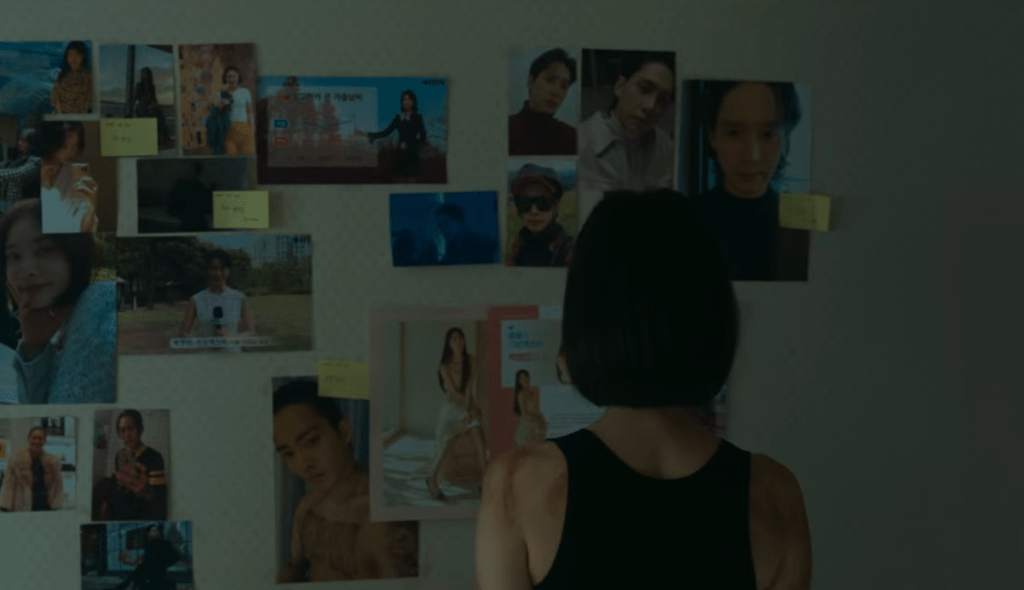
By the end of the episode, we learn that Yeon-jin has become a well-known news weather forecaster, and Dong-eun has truly spent her whole life planning how to take down Yeon-jin. Her apartment, with pictures, I mean you go, this person has lost her mind. But you understand why.
Both characters, Dong-eun and Yeon-jin are two sides of the same coin of institutional failure. Yeon-jin having money and connections coupled with a belief that if you have money and connections you are above the law leads to a child doing the things Yeon-jin does. And Dong-eun who is on the opposite end, since she doesn’t have any money, coupled with a belief that you are less than a bug if you don’t leads to people telling her she should accept her abuse, she should be quiet about her abuse, and worst of all, she deserves her abuse. Dong-eun’s mother failed her, her homeroom teacher, all the other teachers, the police, everyone failed Dong-eun and so she spirals into insanity with her revenge or at least that is how it looks with this first episode.
But it does make you ask yourself, why do we ask those who have been abused to move on and grow past their past? Often, abusers remain the same, finding new victims or readjusting their methods. We never ask them to grow up, reform, or even apologize. Why do we ask those who have received the worst to behave the best?



 They Don't Kiss Until Episode 16
Leave a comment